
Research
My research focuses on AR/VR/MR, computer vision and computational imaging. I study how light, geometry, materials, imaging devices, and learned representations interact with the physical world. I develop projector-camera (ProCam) and spatial augmented reality (SAR) systems that can perceive, simulate, and modify the appearance of real scenes. Related research addresses 3D vision, visual privacy and security, and interdisciplinary visual computing.
Projector-Camera Systems (ProCams) & Spatial Augmented Reality (SAR)
Research questionHow can projected light become a reliable computational interface between digital content and real-world environments?
We study projector-camera systems as a computational interface for modifying and augmenting the appearance of the physical world. Our work spans projector compensation, relighting, project-and-capture modeling, and Spatial Augmented Reality (SAR). It has progressed from learning-based photometric compensation to unified geometric-photometric modeling, efficient and setup-independent deployment, physically based and 3D-aware ProCam simulation, and intelligent SAR. Across these stages, the central goal is to determine how projected light should be generated and adapted so that digital content can interact reliably with real surfaces, scenes, and users.
Research trajectory
-
Learning-based compensation
-
Unified ProCam modeling
-
Efficient / practical compensation
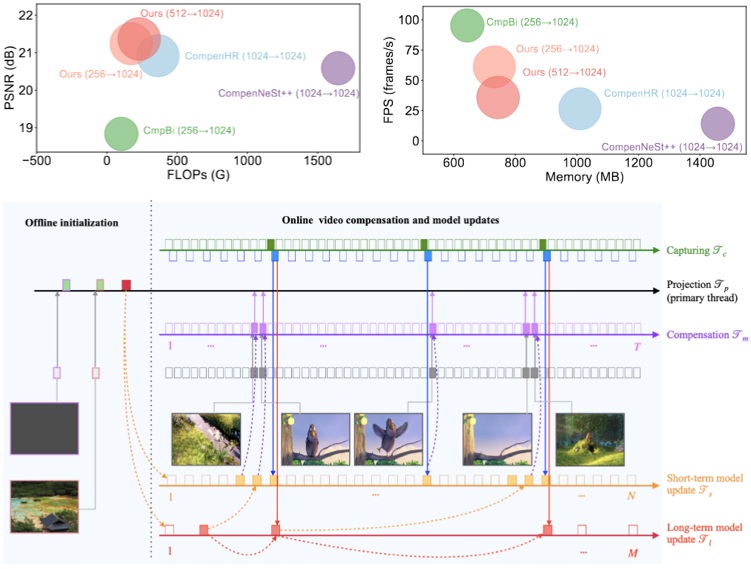
-
Physics- and 3D-aware ProCams
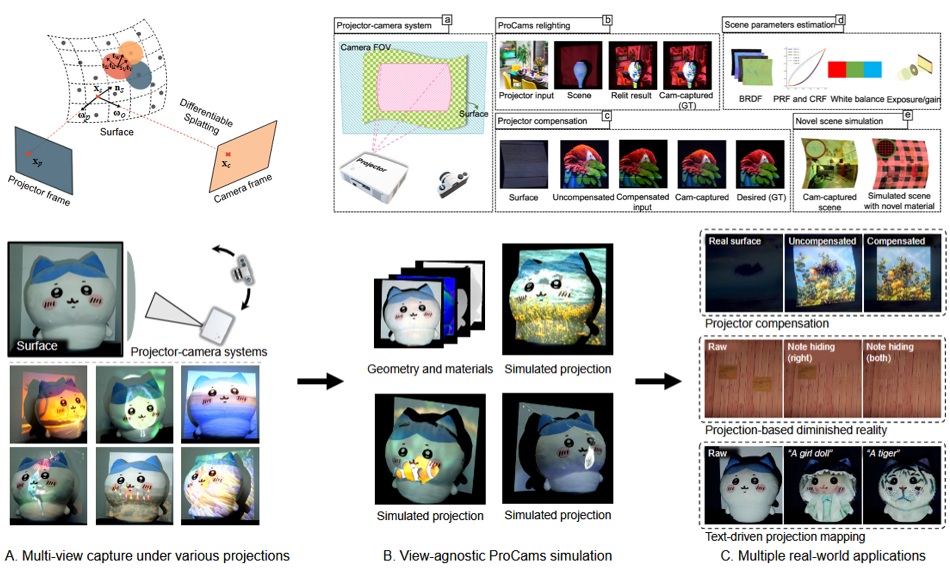
-
Generalization / modern generative modeling
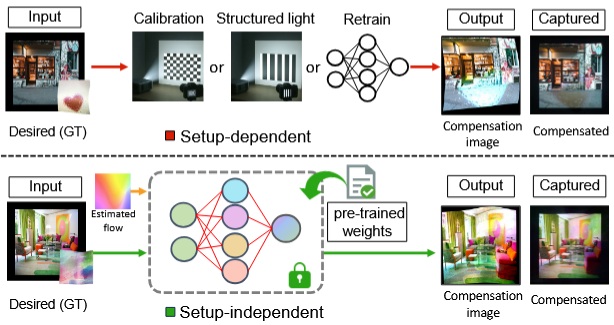
-
Intelligent SAR
Publications (12)
-
Setup-Independent Full Projector Compensation
Haibo Li, Qingyue Deng, Jijiang Li, Haibin Ling, Bingyao Huang
IEEE Transactions on Visualization and Computer Graphics (TVCG), 2026
Also in IEEE Conference on Virtual Reality and 3D User Interfaces (IEEE VR), 2026 (🏆Best Paper Award)
Paper Paper (arXiv) Project Code -
ProCap: Projection-Aware Captioning for Spatial Augmented Reality
Zimo Cao, Yuchen Deng, Haibin Ling, Bingyao Huang
IEEE Conference on Virtual Reality and 3D User Interfaces (IEEE VR), 2026
Paper Paper (arXiv) Project Code -
Real-Time High-Resolution Projector Compensation
Mingjie Chen, Bingyao Huang
IEEE International Conference on Multimedia and Expo (ICME), 2025
Paper Code -
DPCS: Path Tracing-Based Differentiable Projector-Camera Systems
Jijiang Li, Qingyue Deng, Haibin Ling, Bingyao Huang
IEEE Transactions on Visualization and Computer Graphics (TVCG), 2025
Also in IEEE Conference on Virtual Reality and 3D User Interfaces (IEEE VR), 2025
Paper Paper (arXiv) Project Code -
GS-ProCams: Gaussian Splatting-Based Projector-Camera Systems
Qingyue Deng, Jijiang Li, Haibin Ling, Bingyao Huang
IEEE Transactions on Visualization and Computer Graphics (TVCG), 2025
Also in IEEE International Symposium on Mixed and Augmented Reality (ISMAR), 2025
Paper Paper (arXiv) Project Code -
LAPIG: Language Guided Projector Image Generation with Surface Adaptation and Stylization
Yuchen Deng, Haibin Ling, Bingyao Huang
IEEE Transactions on Visualization and Computer Graphics (TVCG), 2025
Also in IEEE Conference on Virtual Reality and 3D User Interfaces (IEEE VR), 2025
Paper Paper (arXiv) Project Code -
ViComp: Video Compensation for Projector-Camera Systems
Yuxi Wang, Haibin Ling, Bingyao Huang
IEEE Transactions on Visualization and Computer Graphics (TVCG), 2024
Also in IEEE Conference on Virtual Reality and 3D User Interfaces (IEEE VR), 2024
Paper Code -
CompenHR: Efficient Full Compensation for High-Resolution Projector
Yuxi Wang, Haibin Ling, Bingyao Huang
IEEE Conference on Virtual Reality and 3D User Interfaces (IEEE VR), 2023
Paper (arXiv) Paper Paper (PDF) Project Code Supplementary (Google Drive) -
End-to-End Full Projector Compensation
Bingyao Huang, Tao Sun, Haibin Ling
IEEE Transactions on Pattern Analysis and Machine Intelligence (TPAMI), 2022
Some preliminary results appear in CVPR 2019 and ICCV 2019.
Paper Paper (arXiv) Project Code Supplementary (Google Drive) -
DeProCams: Simultaneous Relighting, Compensation and Shape Reconstruction for Projector-Camera Systems
Bingyao Huang, Haibin Ling
IEEE Transactions on Visualization and Computer Graphics (TVCG), 2021
Also in IEEE Conference on Virtual Reality and 3D User Interfaces (IEEE VR), 2021 (🏆Best Journal Paper Award)
Paper Paper (arXiv) Project Code Supplementary (Google Drive) Video -
End-To-End Projector Photometric Compensation
Bingyao Huang, Haibin Ling
IEEE Conference on Computer Vision and Pattern Recognition (CVPR) (oral), 2019
Paper Paper (arXiv) Project Code Supplementary -
CompenNet++: End-to-End Full Projector Compensation
Bingyao Huang, Haibin Ling
IEEE International Conference on Computer Vision (ICCV), 2019
Paper Paper (arXiv) Project Code Supplementary
Physics-Informed 3D Vision & Computational Imaging
Research questionHow can physical models, geometry, and learned priors help recover scene structure, appearance, and 3D representations from visual measurements?
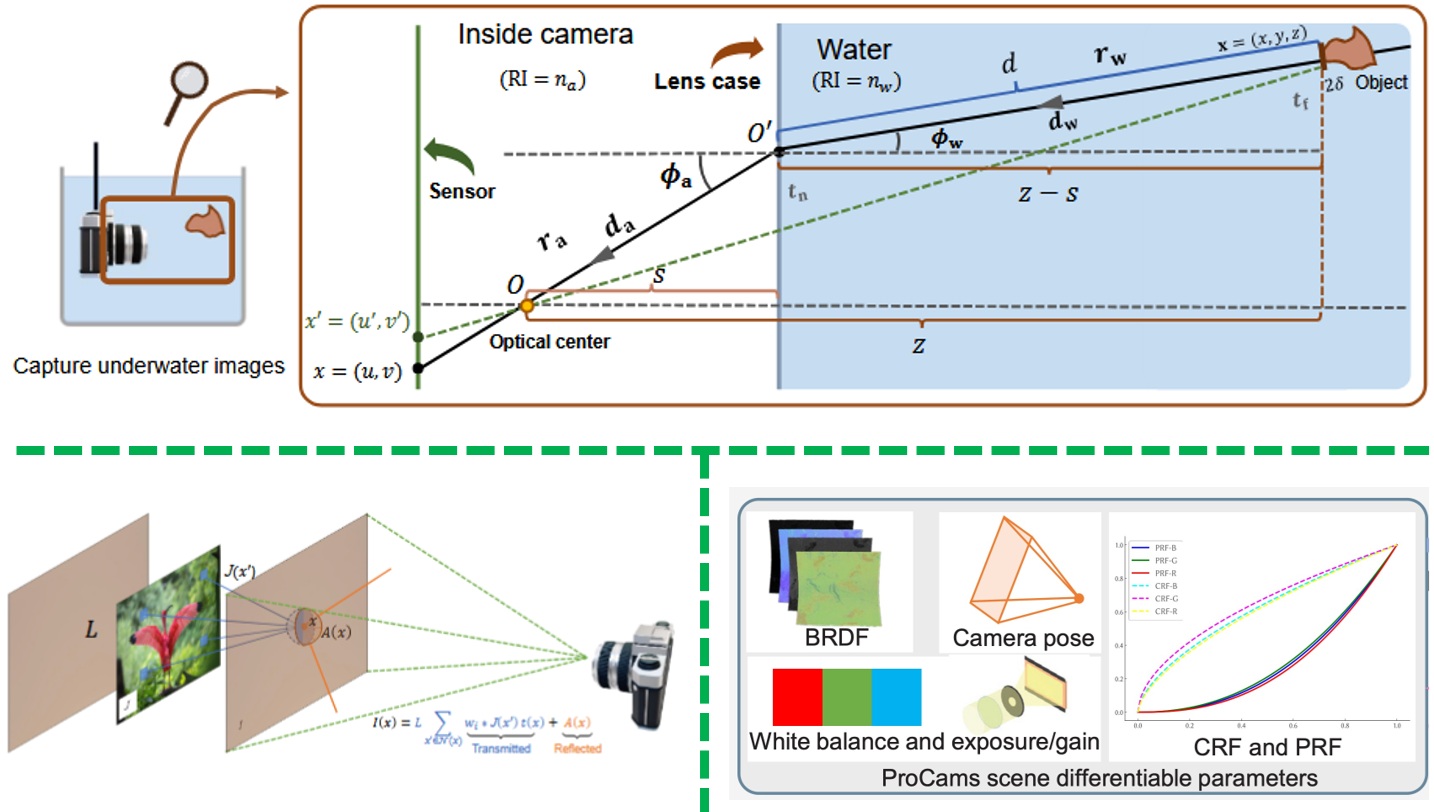
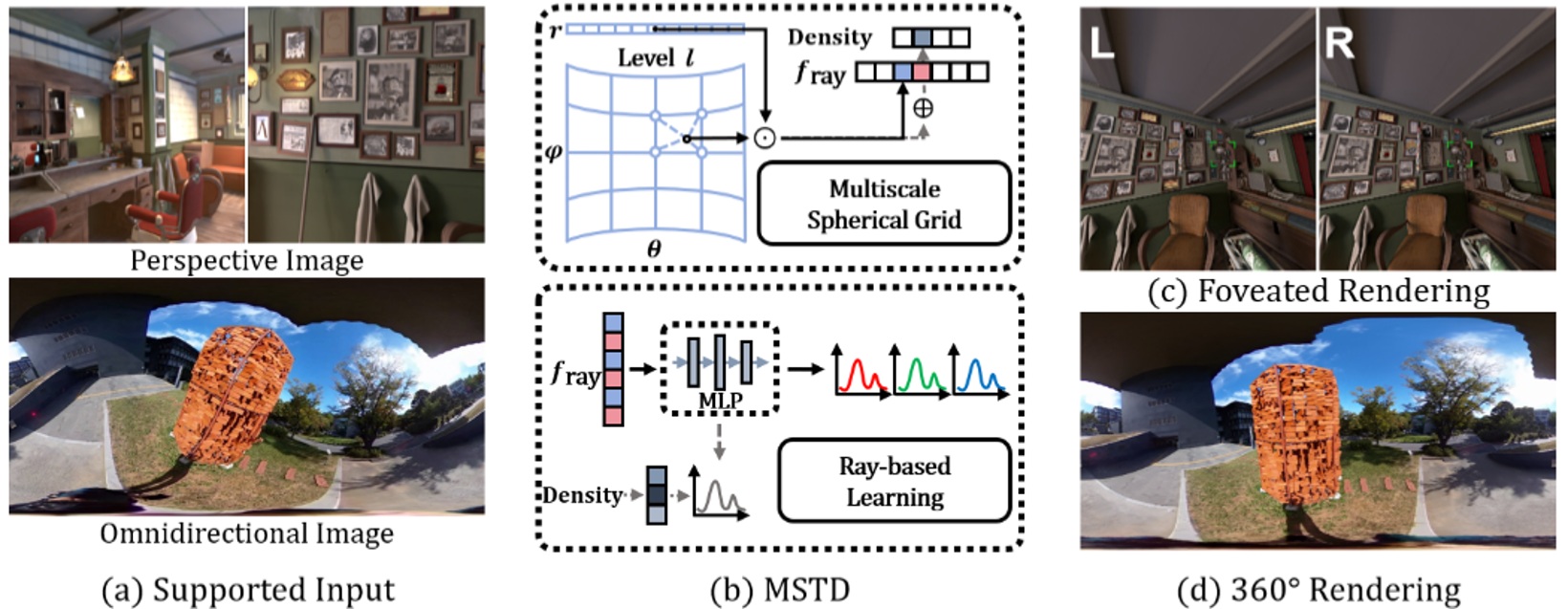
We study inverse problems in computer vision, recovering scene structure and physical properties from incomplete or distorted measurements. Our work combines active sensing, geometric constraints, optical image formation, differentiable rendering, and learned priors to estimate depth, shape, appearance, and scene representations. Applications include projector-camera calibration, structured-light reconstruction, imaging through challenging optical media, and neural or explicit 3D scene representations. We use physical models to constrain and guide these inference problems. These models also address Spatial Augmented Reality (SAR) problems, supporting scene-aware projection, appearance control, and alignment of digital content with real surfaces.
Research framework
-
Active Sensing & Measurement
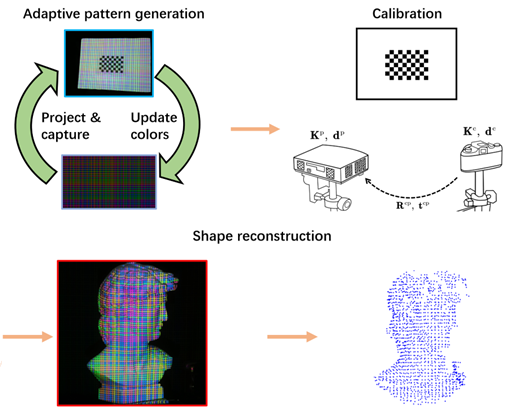
-
Physics-Based Image Formation
-
Physics-Guided Reconstruction
-
3D Representation & Synthesis
Publications (8)
-
DPCS: Path Tracing-Based Differentiable Projector-Camera Systems
Jijiang Li, Qingyue Deng, Haibin Ling, Bingyao Huang
IEEE Transactions on Visualization and Computer Graphics (TVCG), 2025
Also in IEEE Conference on Virtual Reality and 3D User Interfaces (IEEE VR), 2025
Paper Paper (arXiv) Project Code -
GS-ProCams: Gaussian Splatting-Based Projector-Camera Systems
Qingyue Deng, Jijiang Li, Haibin Ling, Bingyao Huang
IEEE Transactions on Visualization and Computer Graphics (TVCG), 2025
Also in IEEE International Symposium on Mixed and Augmented Reality (ISMAR), 2025
Paper Paper (arXiv) Project Code -
Ray-Based Multiscale Spherical Grid for Egocentric Viewing
Weichao Song, Bingyao Huang
IEEE Conference on Virtual Reality and 3D User Interfaces Abstracts and Workshops (VRW), 2025
Paper -
NeuroPump: Simultaneous Geometric and Color Rectification for Underwater Images
Yue Guo, Haoxiang Liao, Haibin Ling, Bingyao Huang
ACM Multimedia Conference (ACM MM), 2025
Paper Paper (arXiv) Project Code Supplementary (PDF) -
Adaptive Color Structured Light for Calibration and Shape Reconstruction
Xin Dong, Haibin Ling, Bingyao Huang
IEEE International Symposium on Mixed and Augmented Reality (ISMAR), 2023
Paper Paper (Google Drive) Project Code Supplementary (Google Drive) -
A Fast and Flexible Projector-Camera Calibration System
Bingyao Huang, Ying Tang, Samed Ozdemir, Haibin Ling
IEEE Transactions on Automation Science and Engineering (TASE), 2021
Paper Project Code Video -
DeProCams: Simultaneous Relighting, Compensation and Shape Reconstruction for Projector-Camera Systems
Bingyao Huang, Haibin Ling
IEEE Transactions on Visualization and Computer Graphics (TVCG), 2021
Also in IEEE Conference on Virtual Reality and 3D User Interfaces (IEEE VR), 2021 (🏆Best Journal Paper Award)
Paper Paper (arXiv) Project Code Supplementary (Google Drive) Video -
A Single-Shot-Per-Pose Camera-Projector Calibration System for Imperfect Planar Targets
Bingyao Huang, Samed Ozdemir, Ying Tang, Chunyuan Liao, Haibin Ling
IEEE International Symposium on Mixed and Augmented Reality Adjunct (ISMAR-Adjunct), 2018
Paper Paper (arXiv) Project Code
Visual Privacy & Physical-World Security
Research questionWhat new attacks and defenses arise when computer vision interacts with physical light transport rather than only digital pixels?
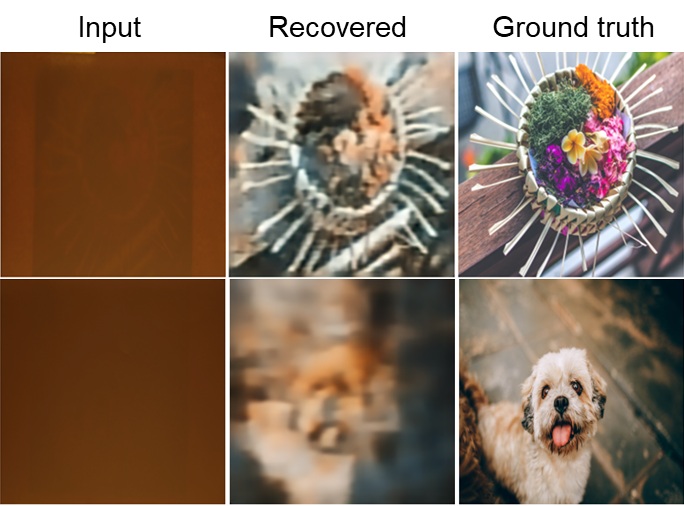
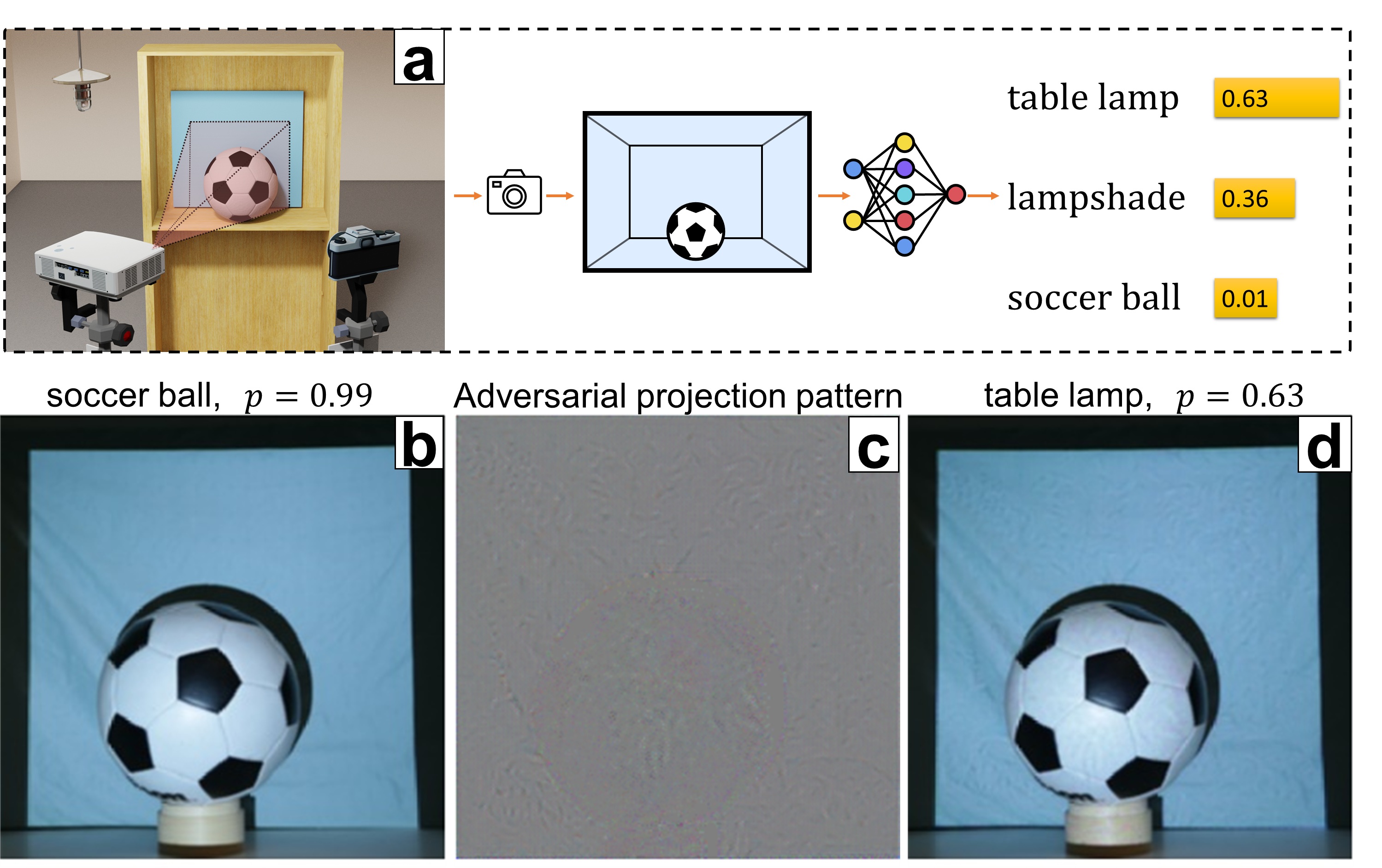
We study privacy and security problems that emerge when machine perception interacts with the physical world. One line investigates information leakage through ordinary optical media and privacy risks introduced by learning-based computational imaging. Another studies projector-based adversarial attacks, where controllable light modifies the appearance observed by vision systems without permanently altering objects. This work progresses from stealthy projector attacks to classifier-agnostic and view-invariant attacks, combining differentiable project-and-capture models with increasingly realistic physical scene representations. This research also informs Spatial Augmented Reality (SAR), where projected content can influence machine perception of the underlying physical scene.
Research trajectory
-
Physical mail privacy: attack & defense
-
Stealthy differentiable projector attack
-
Classifier-agnostic projector attack
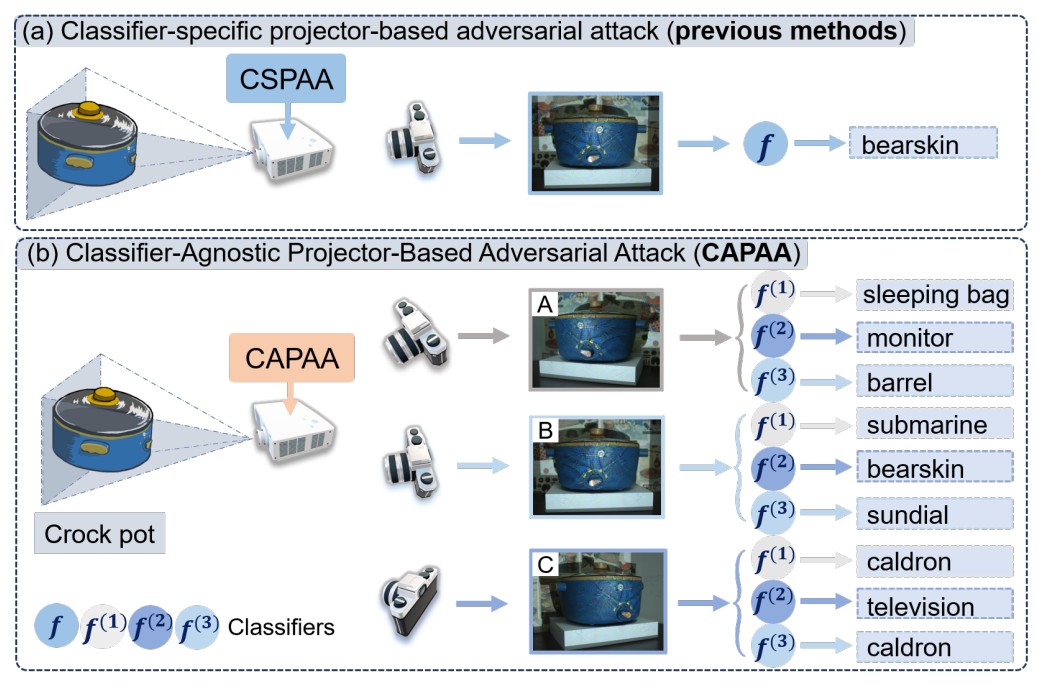
-
View-invariant & classifier-agnostic physical attack
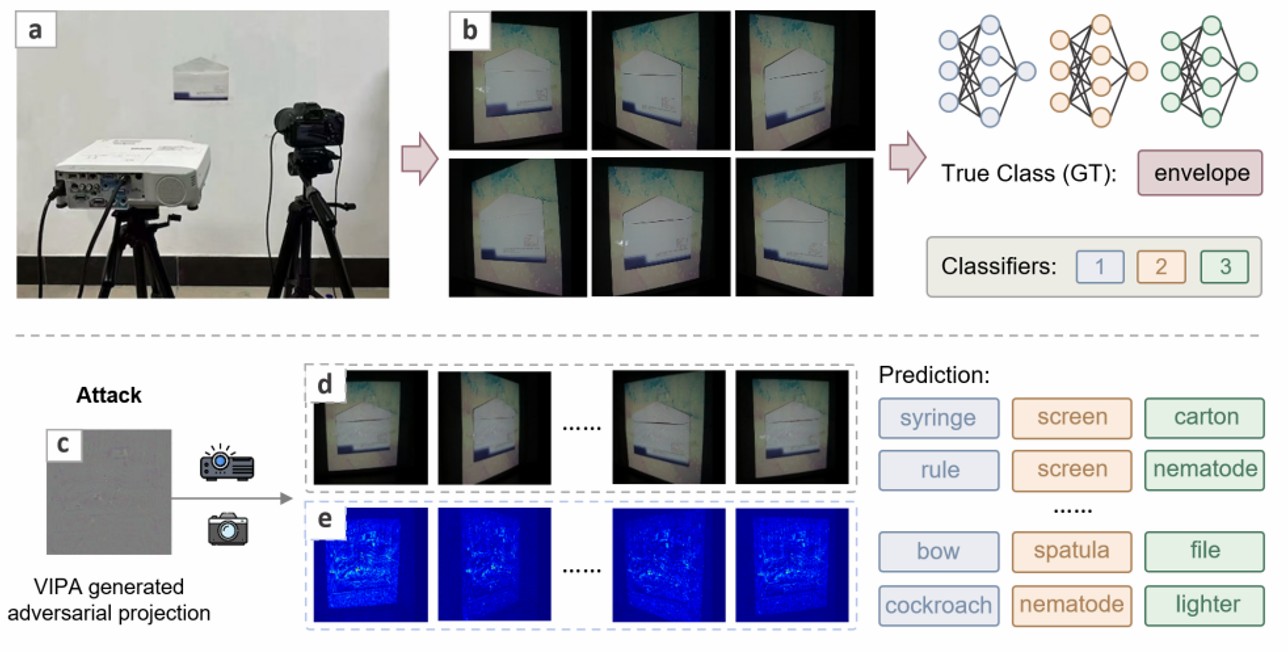
Publications (4)
-
VIPA: View-Invariant Projector-Based Adversarial Attack
Jiyu Han, Qingyue Deng, Bingyao Huang
IEEE Transactions on Visualization and Computer Graphics (TVCG), 2026 (In press)
Also in IEEE International Symposium on Mixed and Augmented Reality (ISMAR), 2026
Project Code -
CAPAA: Classifier-Agnostic Projector-Based Adversarial Attack
Zhan Li#, Mingyu Zhao#, Xin Dong, Haibin Ling, Bingyao Huang
IEEE International Conference on Multimedia and Expo (ICME), 2025
Paper Paper (arXiv) Code -
SPAA: Stealthy Projector-Based Adversarial Attacks on Deep Image Classifiers
Bingyao Huang, Haibin Ling
IEEE Conference on Virtual Reality and 3D User Interfaces (IEEE VR), 2022
Paper Paper (arXiv) Code Supplementary (Dropbox) Video -
Modeling Deep Learning Based Privacy Attacks on Physical Mail
Bingyao Huang, Ruyi Lian, Dimitris Samaras, Haibin Ling
Proc. of AAAI Conference on Artificial Intelligence (AAAI), 2021
Paper Paper (arXiv) Code Supplementary (Google Drive)
Interdisciplinary collaborations
Scientific & Biomedical Visual Computing
Research questionHow can computer vision extract reliable, interpretable, and useful measurements from specialized scientific and biomedical imagery?
We collaborate with domain experts on scientific and biomedical problems whose data, acquisition conditions, and interpretation requirements differ from conventional vision benchmarks. Our work includes cryo-EM analysis, multi-view biological phenotyping, noninvasive visual classification, and mixed-reality medical training. A recurring goal is to derive reliable structural measurements and interpretable results from these observations through representation learning, multi-view analysis, keypoint-based modeling, and human-centered visualization.
Research topics
-
Scientific Imaging
Orientation / Structure
-
Biological Phenotyping
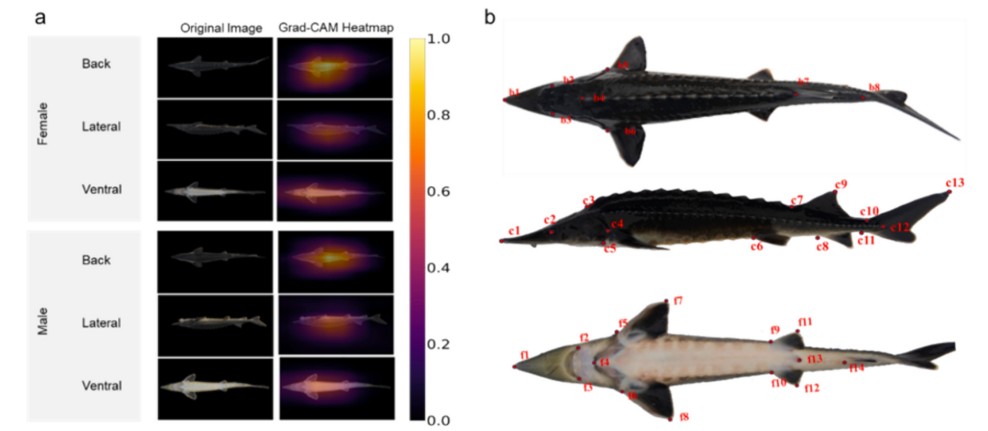
Morphology / Biological Traits
-
Biomedical MR
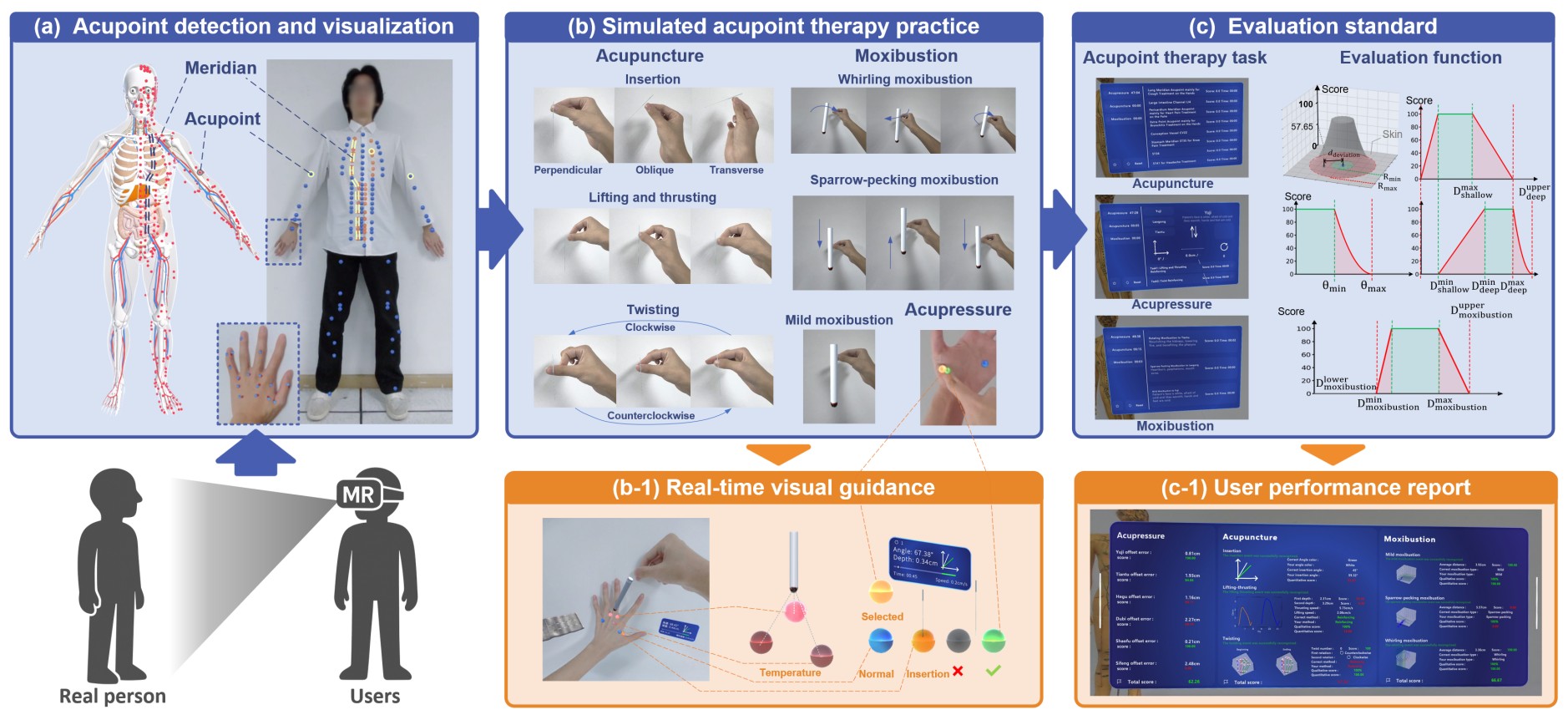
Interactive Training
Publications (4)
-
Non-Invasive Early Sex Identification of Hybrid Sturgeon (Huso Dauricus♀ × Acipenser Schrenckii♂) Based on Multi-View Images
He Gao, Qiaokun Liu, Xiao Chen, Rongzhu Zhou, Shanzhong Zhang, Junting Li, Yinhua Zhou, Suxing Fu, Chengjiang He, Tonghan Wu, Siyu Duan, Jia Xu, Luo Lei, Jian Su, Qiming Wang, Zhaofang Han, Chaowei Zhou, Bingyao Huang, Haiping Liu
Aquaculture, 2026
Paper -
A High-Throughput Phenome-Based Analysis of Morphological Variation and Environmental Adaptation in Extremely High-Altitude Schizothoracine Fishes
He Gao, Suxing Fu, Meng Xing, Yinhua Zhou, Tonghan Wu, Xiao Chen, Chengjiang He, Qiaokun Liu, Haixu Liu, Luo Lei, Shijun Xiao, Fei Liu, Yan Zhou, Jian Su, Chaowei Zhou, Bingyao Huang, Haiping Liu
Water Biology and Security, 2025
Paper -
A Mixed Reality Framework for Acupoint Therapy Teaching: Localization, Practice and Evaluation
Jiacheng Liu, Bohan Chen, Weichao Song, Fangfei Ye, Haibin Ling, Bingyao Huang
IEEE International Symposium on Mixed and Augmented Reality Adjunct (ISMAR-Adjunct), 2025
Paper -
End-to-End Orientation Estimation from 2d Cryo-Em Images
Ruyi Lian, Bingyao Huang, Liguo Wang, Qun Liu, Yuewei Lin, Haibin Ling
Acta Crystallographica Section D - Structural Biology, 2022
Paper