
The problem
Active 3D sensing depends on identifying where projected light is observed. Correspondence errors, imperfect calibration targets, and ambient light can all affect these measurements. This project develops a pipeline for projector-camera correspondence, robust device calibration, and adaptive color structured light for shape reconstruction.
Framework development
-
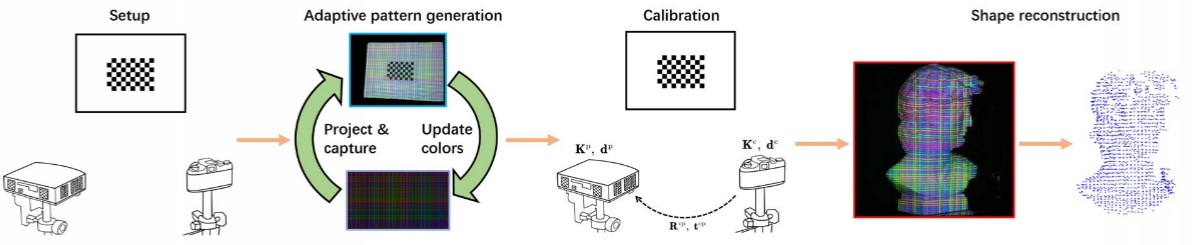
1. Measure correspondence in one shot
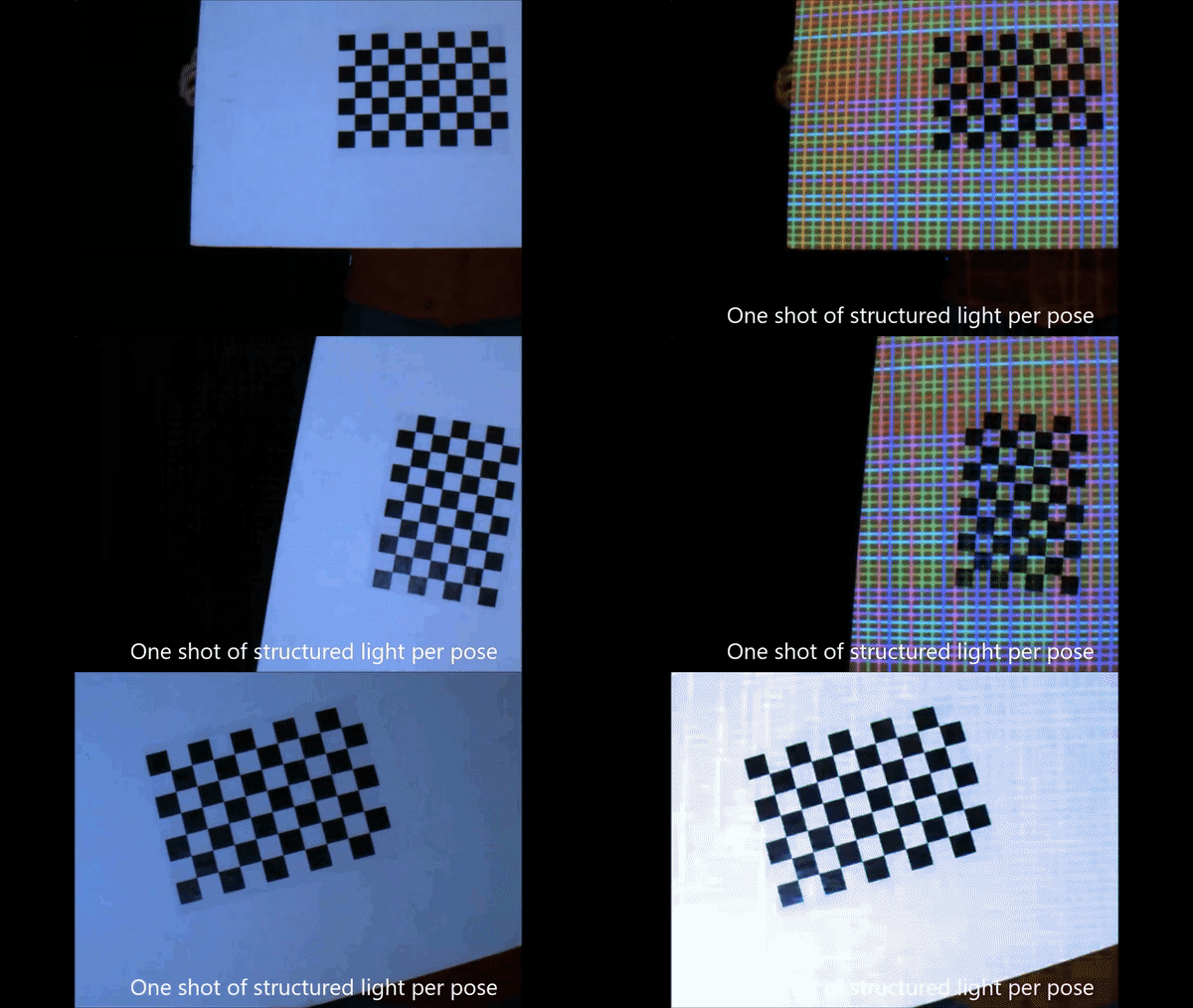
Obtain projector-camera correspondences with one structured-light image per board pose.
-
2. Calibrate robustly
Match color-coded patterns and jointly refine device parameters and measured correspondences.
-
3. Adapt illumination
Choose separable projected colors and detect them using ambient-light and device priors.
From correspondences to calibrated geometry
Single-shot-per-pose measurement
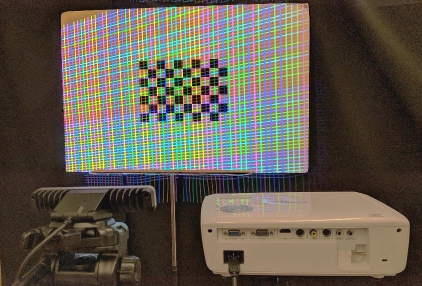
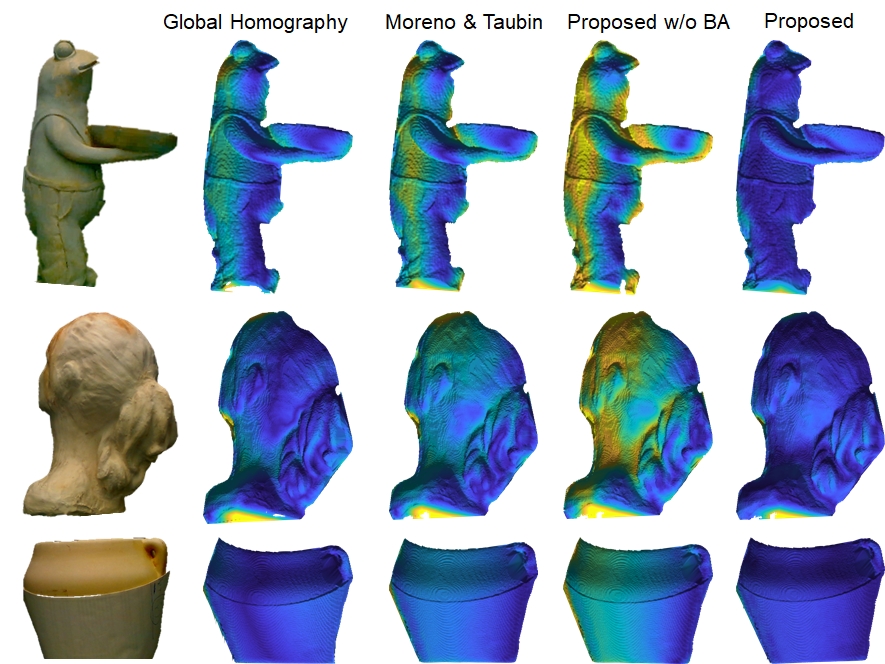
The initial method uses a color-coded spatial structured-light pattern to establish correspondences between the camera image and the projector image. Requiring only one projected pattern per calibration-board pose makes acquisition practical, including when the planar target is imperfect.
Robust calibration and joint refinement
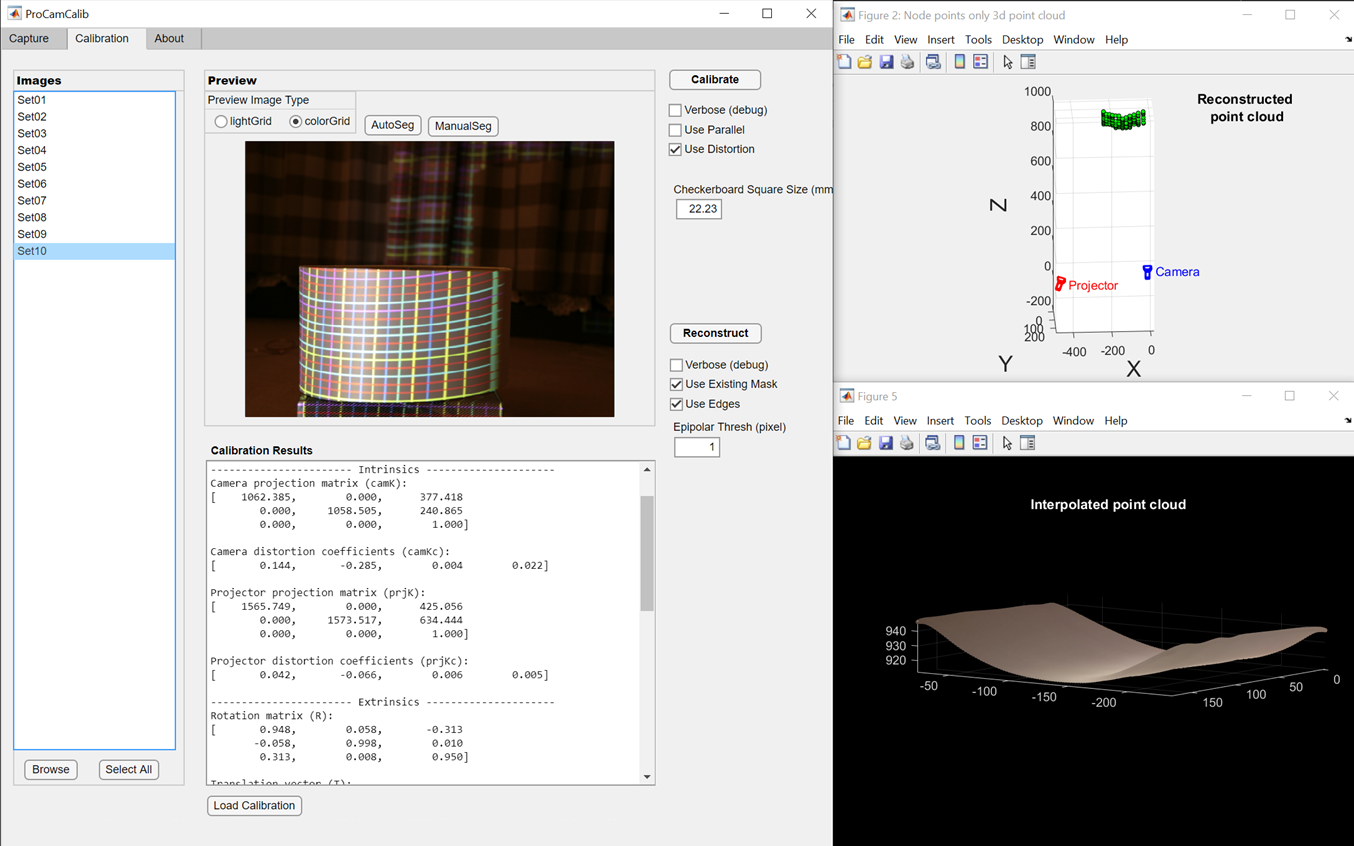
The developed system uses graph-theory-based correspondence matching for an initial calibration, followed by bundle adjustment to jointly refine the device parameters and correspondence coordinates. This addresses measurement noise and imperfect target planarity. The open-source GUI supports the calibration workflow and subsequent reconstruction.
Adapting the measurement to the environment
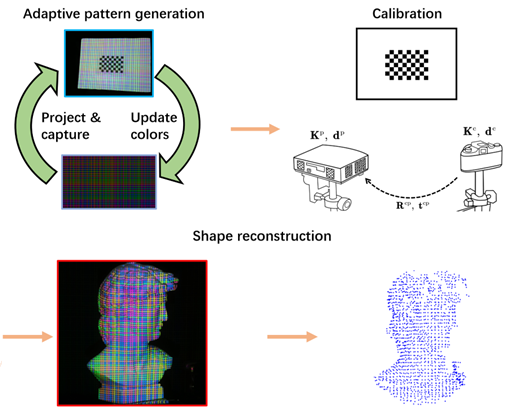
Adaptive color structured light improves the measurements used by the calibration and reconstruction pipeline. Ambient light and device color responses can make projected colors difficult to distinguish. The method selects colors that remain separable in the current setup, then uses maximum a posteriori (MAP) color detection with ambient-light and device priors to estimate correspondences more reliably.
This adaptation does not require preliminary geometric calibration or device response-function calibration. The resulting color measurements support both projector-camera calibration and shape reconstruction.
Calibration software demonstration
Papers and implementations
A Single-Shot-Per-Pose Camera-Projector Calibration System for Imperfect Planar Targets
Bingyao Huang, Samed Ozdemir, Ying Tang, Chunyuan Liao, Haibin Ling
IEEE International Symposium on Mixed and Augmented Reality Adjunct (ISMAR-Adjunct), 2018
Paper Paper (arXiv) Project Code
A Fast and Flexible Projector-Camera Calibration System
Bingyao Huang, Ying Tang, Samed Ozdemir, Haibin Ling
IEEE Transactions on Automation Science and Engineering (TASE), 2021
Paper Project Code Video
Adaptive Color Structured Light for Calibration and Shape Reconstruction
Xin Dong, Haibin Ling, Bingyao Huang
IEEE International Symposium on Mixed and Augmented Reality (ISMAR), 2023
Paper Paper (Google Drive) Project Code Supplementary (Google Drive)
Related research topics and projects
Differentiable ProCam systems recover scene parameters by modeling the forward projection-and-capture process. They connect the geometric measurements studied here with relighting and reconstruction. Projector compensation uses those correspondences and device models to control the appearance of projected content; its calibration requirements vary across methods.
Research topics: 3D Vision & Computational Imaging