
The problem
Spatial Augmented Reality projects digital content directly onto physical scenes. Visual fidelity is only part of an intelligent system: it must also choose suitable content and understand which visible information belongs to the projection and which belongs to the real scene. Surface texture and projector brightness constrain generation, while their visual mixture creates ambiguity for scene interpretation.
From surface-aware generation to semantic understanding
-
1. Generate content for the surface
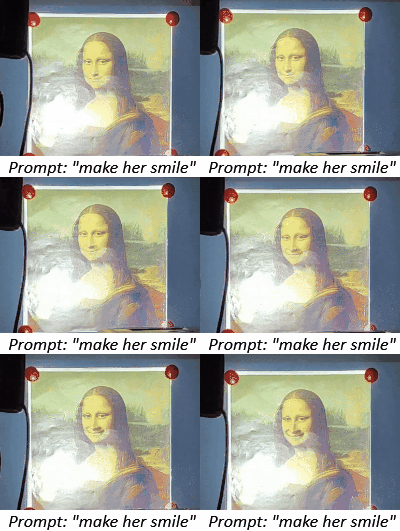
Turn a language prompt into projected stylization while accounting for surface texture and projector limits. GS-ProCams also explores preliminary diffusion-based appearance editing from text.
-
2. Understand projection and scene separately
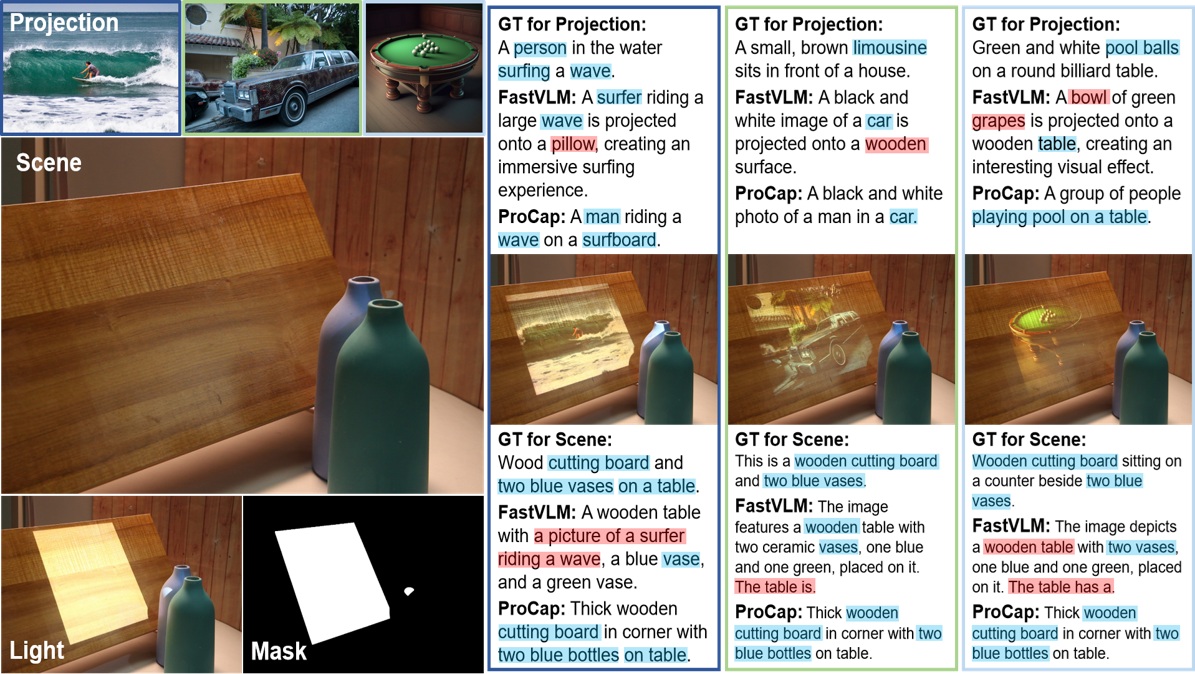
Separate physical and projected layers, then describe each with projection-aware captioning.
Generating a style the surface can display
LAPIG takes a language prompt and generates a projector image that changes the style of a textured surface. Simply generating a desired image and compensating it can leave saturation and texture artifacts because the projector cannot produce every requested appearance.
Projection surface adaptation addresses this constraint during generation. Learned compensation and project-and-capture models make it possible to optimize the image without physically projecting every candidate. Content and saturation losses guide the result toward the requested style while reducing surface-related artifacts. The generated image is then projected to produce the surface stylization.
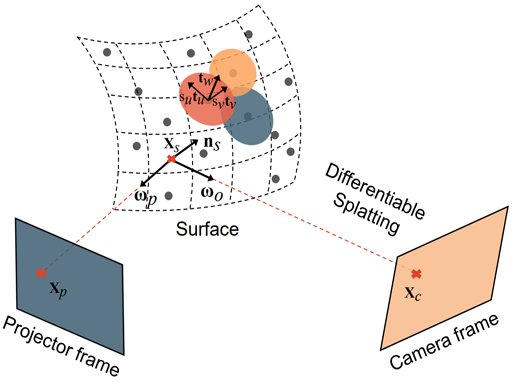
GS-ProCams also includes a preliminary exploration of combining a diffusion model with its projector-camera scene model for text-based appearance editing.
Distinguishing the projection from the physical scene
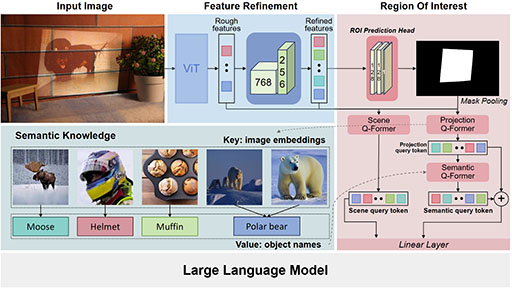
ProCap studies the complementary interpretation problem. A standard vision-language model may describe projected content as if it were part of the physical scene. ProCap separates virtual and physical layers through automated segmentation, then uses region-aware retrieval to reduce ambiguous semantic context caused by projection distortion.
The framework produces separate descriptions of the physical scene and projected content. Its RGBP (RGB + Projections) benchmark provides 65 diverse physical scenes and over 180,000 projections with dense, decoupled annotations for both layers, and dual-captioning evaluation measures how well the generated descriptions distinguish them.
Papers and implementations
LAPIG: Language Guided Projector Image Generation with Surface Adaptation and Stylization
Yuchen Deng, Haibin Ling, Bingyao Huang
IEEE Transactions on Visualization and Computer Graphics (TVCG), 2025
Also in IEEE Conference on Virtual Reality and 3D User Interfaces (IEEE VR), 2025
Paper Paper (arXiv) Project Code
GS-ProCams: Gaussian Splatting-Based Projector-Camera Systems
Qingyue Deng, Jijiang Li, Haibin Ling, Bingyao Huang
IEEE Transactions on Visualization and Computer Graphics (TVCG), 2025
Also in IEEE International Symposium on Mixed and Augmented Reality (ISMAR), 2025
Paper Paper (arXiv) Project Code
ProCap: Projection-Aware Captioning for Spatial Augmented Reality
Zimo Cao, Yuchen Deng, Haibin Ling, Bingyao Huang
IEEE Conference on Virtual Reality and 3D User Interfaces (IEEE VR), 2026
Paper Paper (arXiv) Project Code
Related research topics and projects
Projector Compensation provides methods for controlling captured appearance on real surfaces. Differentiable & 3D ProCam Systems supplies forward models of projection, surface geometry, and light transport. These physical foundations support intelligent SAR, where the goals also involve language, content generation, and semantic distinction.
Research topics: ProCam & SAR